
Please sign in so that we can notify you about a reply
Indications/Uses
Doxycycline is clinically effective in the treatment of variety of infections such as: Rickettsial infections including ehrlichiosis, typhus, spotted fever, trench fever and Q fever; chlamydial infections including psittacosis, lymphogranuloma venereum, trachoma, non-gonococcal urethritis; mycoplasmal infections especially pneumonia; Legionnare's disease; gonorrhea and syphilis; and surgical infections prophylaxis. Prophylaxis of leptospirosis.
Dosage/Direction for Use
Usual Adult Dose: 200 mg (2 capsules) on the first day (as a single dose) or 100 mg (1 capsule) repeated after 12 hours, followed by 100 mg (1 capsule) daily.
Children above 8 years old weighing 45 kg or less: The usual dose is 4 mg/kg body weight in 2 divided doses initially (on the first day) followed by 2 mg/kg body weight daily. In severe infections, the initial dosage is maintained throughout the course of treatment.
Patients with sensitive gonococcal infections: 300 mg (3 capsules) as a single dose or followed by a second similar dose one hour later.
Patients with Syphilis: 200 mg (2 capsules) or 300 mg (3 capsules daily for at least 14 or 10 days respectively.
Treatment of acne: 50 mg daily.
For relapsing fever and louse-borne typhus: 100 mg (1 capsule) or 200 mg (2 capsules) as a single dose.
For prophylaxis of scrub typhus: 200 mg (2 capsules) as a single dose.
For prophylaxis of leptospirosis: 200 mg once every 7 days.
Prophylaxis should be initiated 1 to 2 days before exposure and continued throughout the period of exposure.
Or as prescribed by a physician.
Children above 8 years old weighing 45 kg or less: The usual dose is 4 mg/kg body weight in 2 divided doses initially (on the first day) followed by 2 mg/kg body weight daily. In severe infections, the initial dosage is maintained throughout the course of treatment.
Patients with sensitive gonococcal infections: 300 mg (3 capsules) as a single dose or followed by a second similar dose one hour later.
Patients with Syphilis: 200 mg (2 capsules) or 300 mg (3 capsules daily for at least 14 or 10 days respectively.
Treatment of acne: 50 mg daily.
For relapsing fever and louse-borne typhus: 100 mg (1 capsule) or 200 mg (2 capsules) as a single dose.
For prophylaxis of scrub typhus: 200 mg (2 capsules) as a single dose.
For prophylaxis of leptospirosis: 200 mg once every 7 days.
Prophylaxis should be initiated 1 to 2 days before exposure and continued throughout the period of exposure.
Or as prescribed by a physician.
Administration
May be taken with or without food: Take w/ a full glass of water & remain upright for at least 30 min. Take w/ food or milk if GI irritation occurs.
Contraindications
Contraindicated to patients known to be hypersensitive to Tetracyclines.
Special Precautions
Oesophageal ulceration may be a particular problem if capsule or tablets are taken with insufficient fluid or in a recumbent posture: Doxycycline should be taken with at least half a glass of water. Use of Doxycycline in pregnant women should be avoided.
Care should be taken in giving tetracycline to nursing mothers and children as this may cause permanent discoloration to the child's teeth.
Exceeding the recommended dosage may increase the incidence of side effects.
Care should be taken in giving tetracycline to nursing mothers and children as this may cause permanent discoloration to the child's teeth.
Exceeding the recommended dosage may increase the incidence of side effects.
Adverse Reactions
Nausea, vomiting, diarrhea, dry mouth, glossitis, discoloration of the tongue, stomatitis, dysphagia, oesophageal ulceration, oral candidiasis, vulvovaginitis and pruritus, enterocolitis, severe uraemia and hepatoxicity.
Drug Interactions
The absorption of Doxycycline is reduced by divalent and trivalent cations such as aluminum, bismuth, calcium, iron, magnesium and zinc and therefore, concomitant administration of tetracyclines with antacids, iron preparations, some foods such as milk and dairy products or other preparations containing such cations, whether as active ingredients or excipients may result in subtherapeutic serum concentrations of the antibacterial.
Sodium bicarbonate, colestipol and kaolin-pectin will also reduce its absorption. Its nephrotoxic effects may be exacerbated by diuretics, methoxyflurane or other potentially nephrotoxic drugs.
Sodium bicarbonate, colestipol and kaolin-pectin will also reduce its absorption. Its nephrotoxic effects may be exacerbated by diuretics, methoxyflurane or other potentially nephrotoxic drugs.
Storage
Store at temperatures not exceeding 30°C.
Action
Pharmacology: Pharmacokinetics: Doxycycline is 90% to almost 100% absorbed in the gastrointestinal tract after oral administration, not much affected by milk and food. It is widely distributed in the body tissues and fluids. Plasma half-life is the longest of the tetracyclines, namely 12 to 24 hours which accounts for its slow rate of excretion (25% to 40%).
Doxycycline is excreted slowly in the urine in patients with normal renal function. However, the majority of a dose of doxycycline is excreted in the feces after chelation in the intestines. It does not accumulate significantly in patients with renal impairment.
Doxycycline is excreted slowly in the urine in patients with normal renal function. However, the majority of a dose of doxycycline is excreted in the feces after chelation in the intestines. It does not accumulate significantly in patients with renal impairment.
MedsGo Class
Tetracyclines
Features
Dosage
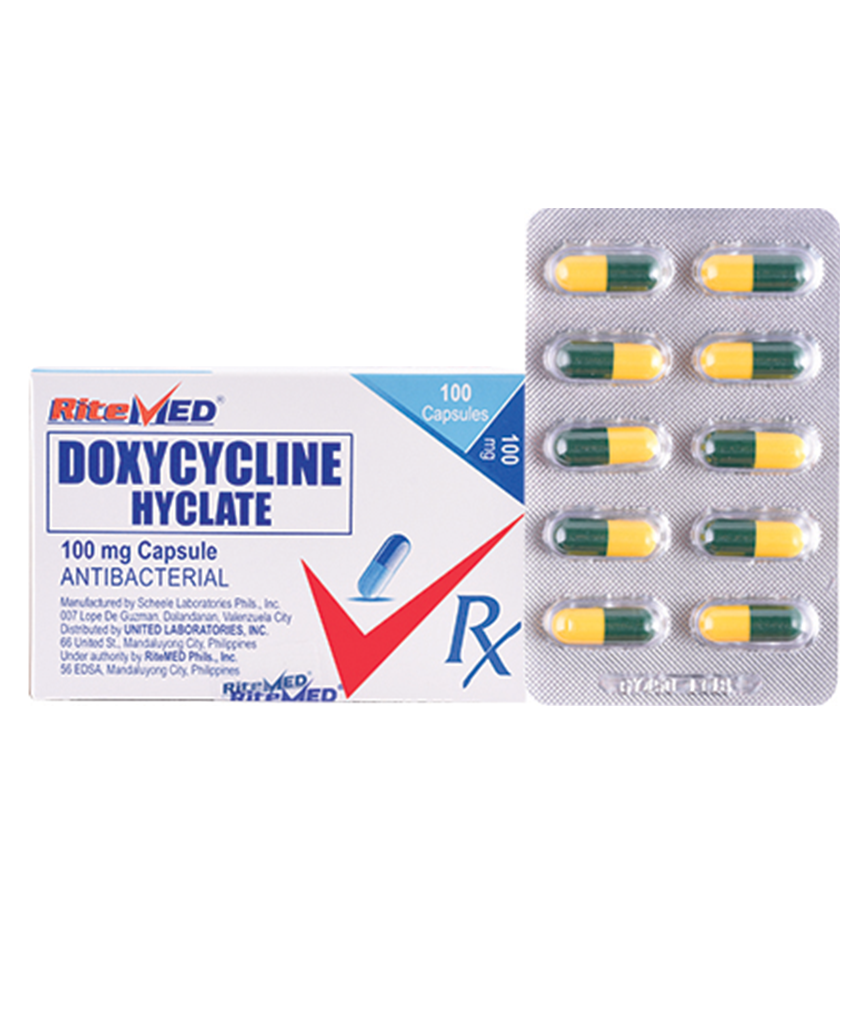
100mg
Ingredients
- Doxycycline
Packaging
Capsule 1's
Generic Name
Doxycycline Hyclate
Registration Number
DRP-2401-04
Classification
Prescription Drug (RX)
Reviews
No reviews found
Product Questions
Questions

